
The Top 5 Leading RWA Platforms and Protocols

For years, the Real-World Asset (RWA) narrative was a theoretical promise. Crypto innovators dreamed of how on-chain finance could transform traditional risk assets.
In 2026, that promise has come true.
Institutional capital no longer sits on the sidelines. They actively participate in the on-chain economy, bringing billions in treasuries, private credit, and equities onto the blockchain.
This article provides a map of the RWA landscape. It explores how the bridge between TradFi and DeFi has evolved into a multi-billion-dollar pillar of the digital economy.
What Are RWA Protocols?
RWA protocols are the infrastructure and applications that bring traditional financial assets such as government bonds, real estate, and private equity onto the blockchain.
By turning these off-chain assets into on-chain tokens, protocols enable 24/7 trading, fractional ownership, and instant settlement.
How RWA Tokenization Works
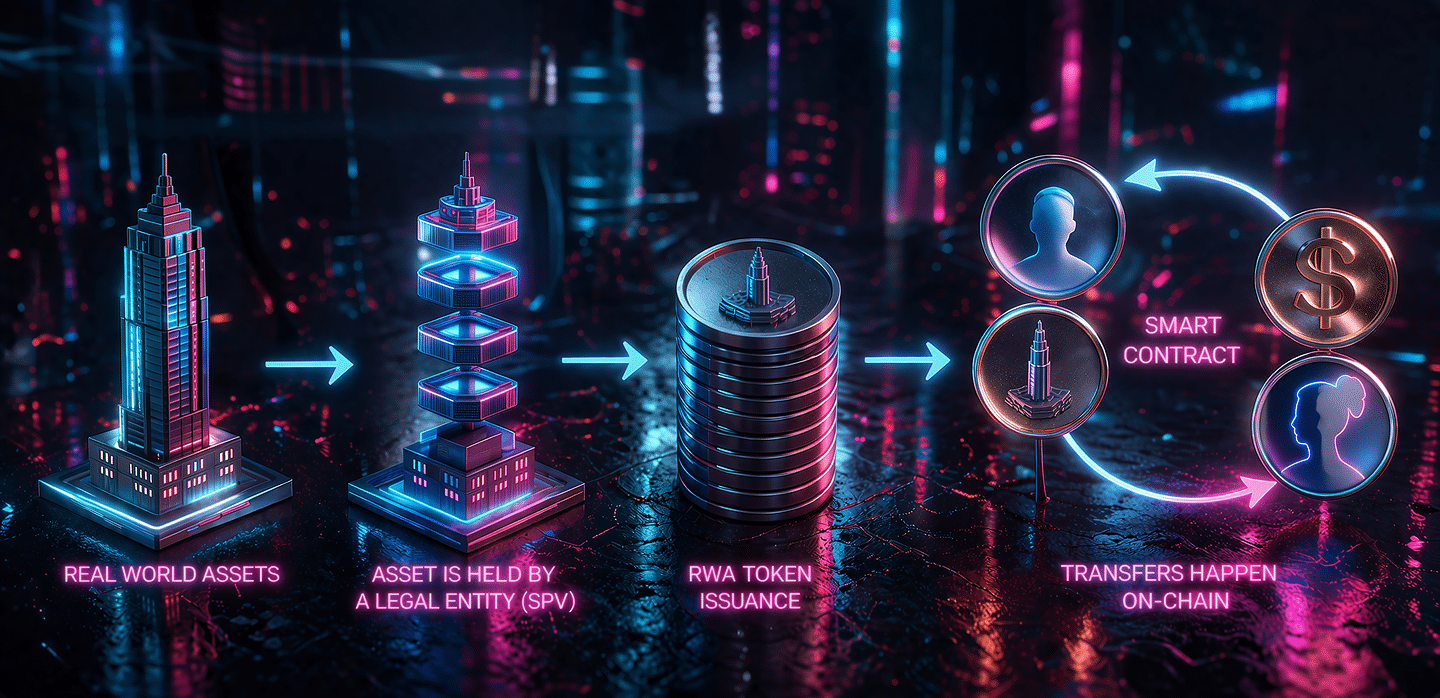
To make it clearer how RWA works, let’s use BlackRock’s BUIDL as an example.
BUIDL is a flagship tokenized money market fund that invests in U.S. Treasury bills. The fund maintains a stable 1:1 peg while distributing accrued yield directly to investors’ wallets.
Designed for institutional treasuries, BUIDL provides 24/7 liquidity by allowing near-instant swaps into USDC, bypassing the multi-day settlement delays typical of traditional finance.
Here’s the process behind bringing traditional assets like treasuries on-chain:
1. Origination & Structuring: An asset, such as a US Treasury bill, is identified and placed into a legal vehicle.
2. Custody: A regulated custodian manages the physical assets to ensure that every digital token is backed by its real-world equivalent.
3. Tokenization: A smart contract issues digital tokens representing a claim on the underlying asset or its yield.
4. Distribution: Investors gain access to these tokens, enabling them to use them as DeFi collateral or for trading activities.
Why RWA Matters for DeFi and TradFi
For decentralized finance, RWAs provide a source of stability. While crypto-native yields, such as staking rewards, often fluctuate with volatile token prices, RWA yields derive from traditional economic activity.
For traditional finance, tokenization eliminates settlement lag, reduces administrative costs, and unlocks liquidity for previously illiquid assets.
Leading RWA Platforms and Protocols
When you think of RWA, you think of crypto native protocols driving the show. However, the landscape has evolved. Both crypto and Wall Street-backed players play a big role in turning on-chain pilots into active global markets.
The RWA ecosystem consists of a multi-layered stack. Specialized platforms handle everything from legal minting to secondary-market liquidity.
1. Securitize – The Institutional Issuance Layer
Securitize is the premier on-ramp for Wall Street. The company is an end-to-end digital securities platform that manages compliance, investor onboarding, and the full asset lifecycle.
The company made waves as the official issuance partner for BlackRock’s BUIDL fund.
As of writing, Securitize manages over $4 billion in on-chain assets, bridging the gap between traditional transfer agents and blockchain settlement. It enables institutions to issue tokenized stocks, private credit, and even real estate with full SEC compliance.
2. Tether – Moving Beyond Stablecoins with Alloy
While known for USDT, the leading stablecoin by market cap, Tether has expanded its RWA footprint through Alloy by Tether. This platform allows users to mint tethered assets, digital tokens that track a reference price, using Tether Gold (XAUT) as over-collateralized backing.
Tether positions itself as the liquidity provider for the RWA space, allowing users to keep the security of gold or US dollars.
3. Circle – The Settlement Infrastructure
Circle is the more regulatory and compliance-friendly version of Tether. Through its Circle Reserve Fund, managed by BlackRock, the reserves backing USDC are themselves largely tokenized or held in high-quality short-term Treasuries.
The publicly listed company provides a 24/7 off-ramp for institutional RWA funds (like BUIDL). They enable investors to swap their tokenized fund shares for USDC instantly.
Circle has over $2.5 billion in on-chain assets, as of writing.
4. Ondo Finance – The DeFi Yield Gateway
Ondo is a crypto-native protocol that bridges retail and institutional investors to institutional-grade yield. As of writing, Ondo secures over $1.1 billion in on-chain assets, dominating the tokenized Treasury market.
Its key products include OUSG, a fund for accredited investors that invests directly into BlackRock’s BUIDL. Most recently, the protocol has moved into tokenizing equities, enabling on-chain trading of Circle and the S&P 500.
5. Centrifuge (CFG) – On-Chain Credit Leader
Centrifuge is a pioneer in the onchain ecosystem for private credit and structured finance.
It serves as a bridge between traditional small- to medium-sized enterprises (SMEs) and DeFi’s decentralized liquidity. By tokenizing non-market-traded assets such as invoices, mortgages, and consumer loans, Centrifuge allows businesses to access financing without traditional banking intermediaries.
Centrifuge currently has $1.6 billion in on-chain RWAs.
Financial Institutions Entering the RWA Space
Global financial giants are no longer just experimenting with private side-chains. They are deploying multi-billion-dollar funds directly onto public rails. This change in attitude transforms how liquidity flows between traditional and decentralized markets.
Here are some of the biggest financial institutions jumping in:
- New York Stock Exchange (NYSE): The NYSE is working with Securitize to build infrastructure that ensures tokenized securities meet traditional market standards. Initial plans focus on high-volume stocks and ETFs.
- Franklin Templeton: Through their BENJI token, they have pioneered the use of public blockchains for sovereign money market funds.
- Janus Henderson: Through a partnership with Centrifuge and Anemoy, the global asset manager brings institutional-grade credit on-chain. They focus on Collateralized Loan Obligations (CLOs).
What Blockchains Are RWA Protocols Built On?
As of writing, the on-chain RWA market cap stands at $23 billion. RWA has seen massive growth, expanding 20x since 2023.
As the ecosystem diversifies, three blockchains have emerged as the primary hubs for nearly 80% of all RWA activity.
- Ethereum: The “Institutional Settlement Layer.” Ethereum remains the top choice for high-TVL protocols and massive funds like BlackRock’s BUIDL, favored for its deep liquidity and battle-tested security.
- Solana: The “High-Velocity Engine.” Thanks to sub-second finality and near-zero fees, Solana has become the premier hub for RWA perpetuals and tokenized stocks (like Nvidia or Tesla) that require real-time trading speeds.
- BNB Chain: The “Middle Ground.” Leveraging its massive exchange-native user base through Binance, BNB Chain is a leader in tokenized gold and money market products.
Final Thoughts on the RWA Landscape
As we move deeper into 2026, the distinction between Real-World Assets and crypto is rapidly blurring. RWAs represent one of the fastest growing sectors of the digital space. It is not hard to imagine how they may become synonymous in the future.
The institutional transition experiments to public rails like Ethereum and Solana prove that the global financial system is ready for a structural upgrade. Whether it is BlackRock managing billions on-chain or a retail user holding fractional shares of the S&P 500, the RWA landscape is becoming clearer.
The future of finance isn’t just digital; it is decentralized, tokenized, and real-world backed.
FAQs
What are RWA protocols in crypto?
RWA protocols use blockchain technology to tokenize physical or traditional financial assets. This tokenization allows traditional assets to be traded 24/7, fractionally owned, and used as collateral within the DeFi ecosystem.
What is the biggest RWA protocol?
While not a DeFi protocol, Securitize is the largest RWA platform, issuing products like BlackRock’s BUIDL.
Which financial institutions are investing in RWA?
The landscape is led by BlackRock, Franklin Templeton, and WisdomTree, all of which operate live tokenized money market funds. Major banks like JPMorgan and HSBC have also moved into producing their own blockchain.
What blockchains support RWA tokenization?
Ethereum remains the dominant settlement layer for institutional funds. However, Solana has become the leader for high-velocity trading and equities, while BNB Chain has emerged as a major hub for retail-facing RWA products and tokenized gold.
The content of solostakers.com is for informational purposes only and should not be considered financial advice. It represents the personal views and opinions of the author(s) and is not endorsed by any financial institution or regulatory body. Cryptocurrency and staking investments carry inherent risks and readers should conduct their own research and consult with a financial professional before making any investment decisions. The owner and author(s) of solostakers.com will not be liable for any losses, damages, or consequences arising from the use of the information on this site. By accessing solostakers.com, you agree to bear full responsibility for your investment decisions.

April 6, 2026
April 6, 2026


