
Solana Staking Risks for Small Holders 2026: What to Avoid When Choosing a Validator
Solana has matured into an institutional powerhouse, with institutions and ETFs buying and staking the token. But for the everyday staker, the landscape can feel like a battlefield.
With the staking participation rate pushing towards 70%, everyone is competing for rewards.
Choosing a validator is no longer about network participation or “stake and forget.” A single change in commission rates can affect your investment growth.
Token price volatility and hardware requirements for validators have increased. Validators can pass costs directly down to you. And if you’re unaware, you’ll be leaking yield.
In this guide, we provide you with a checklist to protect and maximize your SOL…
- What to look for in Solana validators
- Quick validator comparison and rankings
- Staking risks
…and more.
Keep reading to ensure you aren’t leaving money on the table in 2026.
The Ultimate 2026 Retail Validator Checklist
Before you delegate your hard-earned Solana, run your potential validator through these criteria.
1. Commission Rate (The 0–10% Rule)
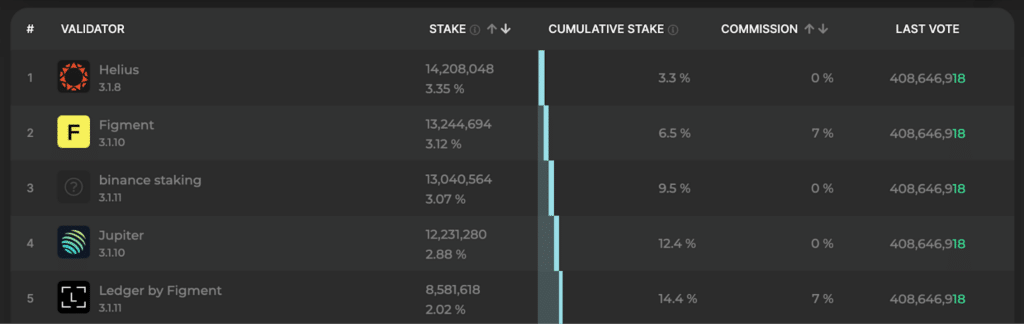
Validators compete for your delegations by dropping commission rates. You can delegate to these “0% fee” validators to maximize staking returns.
However, beware of validators that may bait-and-switch the commission rates. They may be dangling these low fees before increasing them over time. These marketing lures could eventually creep beyond 10%.
2. Commission Transparency
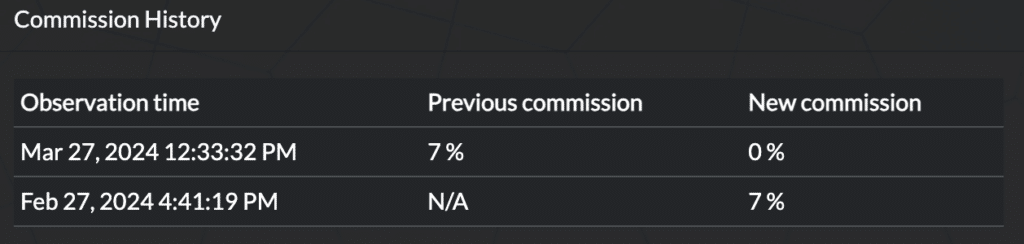
Check the validator’s commission history on sites like Stakewiz.
Watch out for red flags as to when a validator changes its commission rates without any community announcement. While it’s not illegal to increase or decrease commission rates, communication matters.
3. Uptime & Skip Rate (>99.5%)
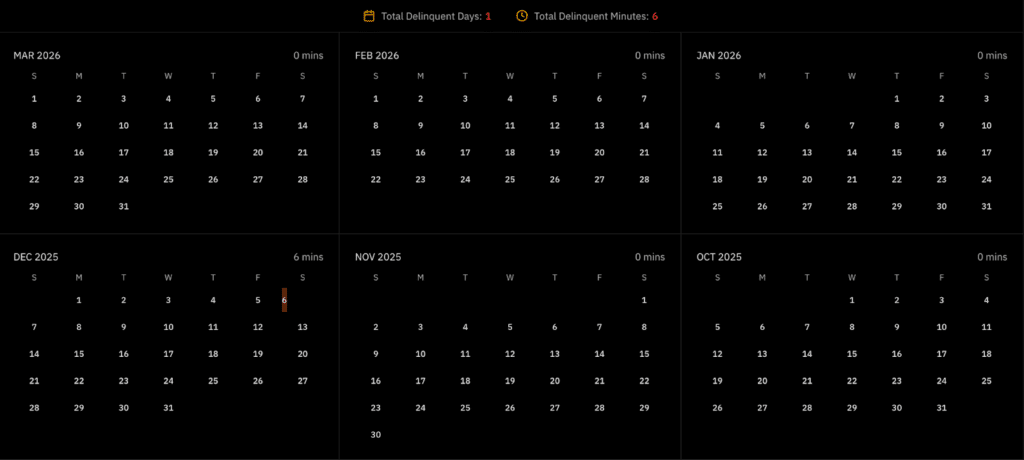
Solana issues rewards every epoch (roughly 2–3 days). If a validator skips blocks or goes offline, you don’t earn for that period. This underperformance can cut your annual staking returns.
You must pick a validator with an uptime close to 100%.
You can use free explorers like Helius’ Orb to see historical delinquency. A validator should not go offline for more than a few minutes every month.
4. Stake Distribution (Avoiding the Superminority)
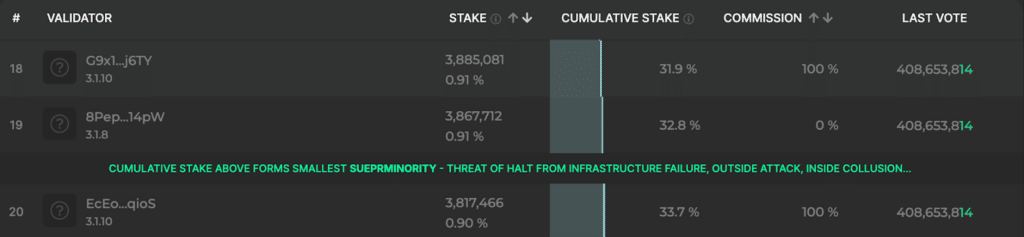
The Superminority is the smallest group of validators capable of collectively halting the Solana network. 19 validators currently comprise the Superminority.
You can actively choose a high-performing validator outside this group. In this way, you help secure the network and may receive better, more personalized support.
Smaller validators may be more responsive to attract delegators.
5. Block Revenue & MEV Sharing
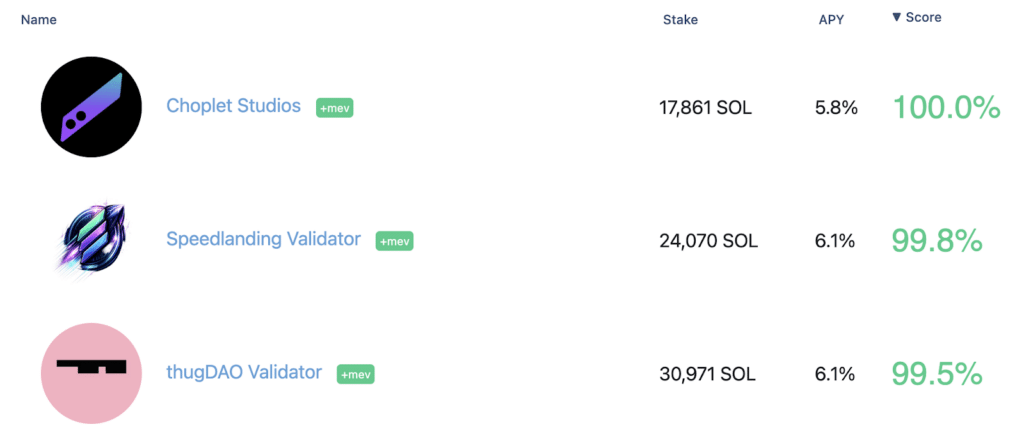
Validators earn more than just inflation. They earn transaction fees and MEV tips.
Maximal Extractable Value (MEV) is the maximum profit that validators, miners, or searchers can gain by manipulating the order of transactions within a block.
Look for validators that share a percentage of MEV rewards with delegators. This reward-sharing can boost your staking yield by a few percentage points.
6. Community Responsiveness
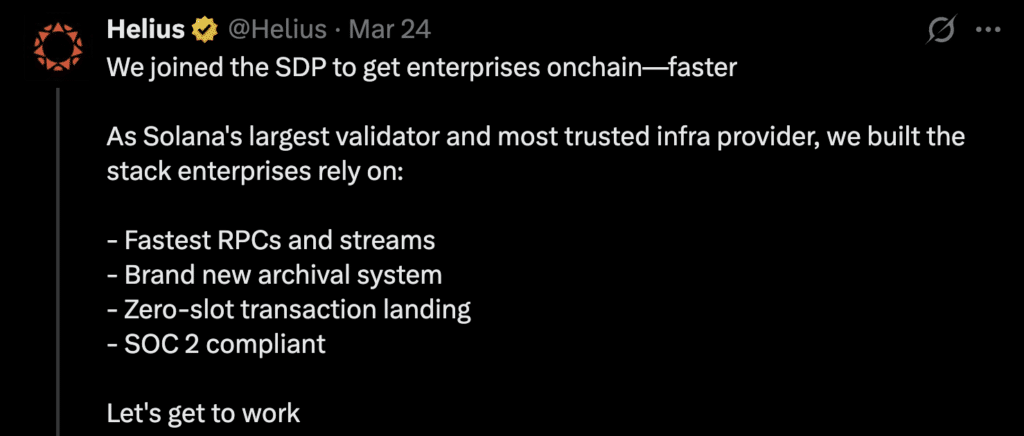
Given how fast crypto moves, retail stakers need to stay up to date on proposals and innovations. While you can read from Solana’s official website and social media pages, it’s also helpful if your validators also send you information.
Helius, the second-largest validator on Solana, runs a highly active X account where they post updates. This active stream of information assures their validators that the team is competent and constantly working behind the scenes.
Top Retail-Friendly Validators 2026
| Validator | APY | MEV | Commission | Uptime | Superminority | Community Engagement |
|---|---|---|---|---|---|---|
| Helius | 6.10% | No | 0% | 99.9% | Yes | Highly active |
| blueshift | 5.90% | Yes | 0% | 99.3% | Yes | Highly active |
| Drift | 5.98% | No | 0% | 99.9% | No | Highly active |
| Nansen | 5.97% | Yes | 0% | 99.8% | No | Highly active |
| Sanctum | 5.87% | No | 0% | 99.8% | No | Highly active |
The validators in the table above seem identical. They all offer 0% commission, have excellent uptime, and actively communicate with their delegators. Except Helius, all validators fall outside the Superminority. By staking with these, you help contribute to network decentralization.
These validators also hold strong reputations within the Solana ecosystem:
- Helius: Solana’s leading RPC and API infrastructure provider and the second-largest validator.
- Blueshift: a prominent developer training platform and educational ecosystem focused on teaching developers how to build on-chain programs on Solana.
- Drift Protocol: a leading decentralized exchange (DEX) built on the Solana blockchain.
- Sanctum: a top liquid staking protocol on Solana designed to unify fragmented liquidity across different liquid staking tokens (LSTs).
Staking Risks for Small Holders: What to Avoid
Fee Erosion (Commission Creep)
For a holder with 10 SOL, a move from 0% to 10% commission might only seem like a few dollars. But over the years of compounding, it represents a significant portion of your principal.
Avoid validators that don’t have a clear, long-term fee structure.
Validator Deactivation (The “Zombie” Risk)
Smaller validators sometimes go “delinquent” if their hardware fails or they can’t afford the upkeep. If your validator goes delinquent, your SOL stays safe, but it earns nothing until you move it.
As a mitigation strategy, you can spread your stake across 2–3 validators to ensure a single failure doesn’t kill your entire yield.
The “Top by Stake” Trap
Many retail users simply click the first name on a “Top Validators” list.
Some of these validators belong to exchanges like Binance or Coinbase and come with higher commission fees than independent high-performance validators. While you can bank on the reputation of these exchanges, you’ll be sacrificing returns.
Final Thoughts
Choosing the right Solana validator in 2026 requires moving past simple APY numbers. By focusing on uptime, MEV sharing, and decentralization, small holders can continue to generate good staking returns while keeping the network healthy.
If managing individual validators feels like too much, consider an AI-Driven optimization platform like Polli.co. Such platforms automatically route your stake to the highest-performing, lowest-risk validators on your behalf.
Frequently Asked Questions
Which Solana validator has the lowest fees and highest uptime right now?
You can choose from several validators that have zero commission and high uptime. Validators such as Helius, blueshift, and Drift meet this criterion.
Do big CEX validators hurt retail yield?
In general, centralized exchange validators charge higher commission, reducing retail staking yield.
Kraken charges a 10% commission while Upbit (Korea) takes 100% of the commission.
Tools to compare validators easily
Retail stakers can choose from free explorers such as Solana Beach, Stakewiz, and Orbmarkets to compare Solana validators.
The content of solostakers.com is for informational purposes only and should not be considered financial advice. It represents the personal views and opinions of the author(s) and is not endorsed by any financial institution or regulatory body. Cryptocurrency and staking investments carry inherent risks and readers should conduct their own research and consult with a financial professional before making any investment decisions. The owner and author(s) of solostakers.com will not be liable for any losses, damages, or consequences arising from the use of the information on this site. By accessing solostakers.com, you agree to bear full responsibility for your investment decisions.

March 29, 2026
March 29, 2026


